

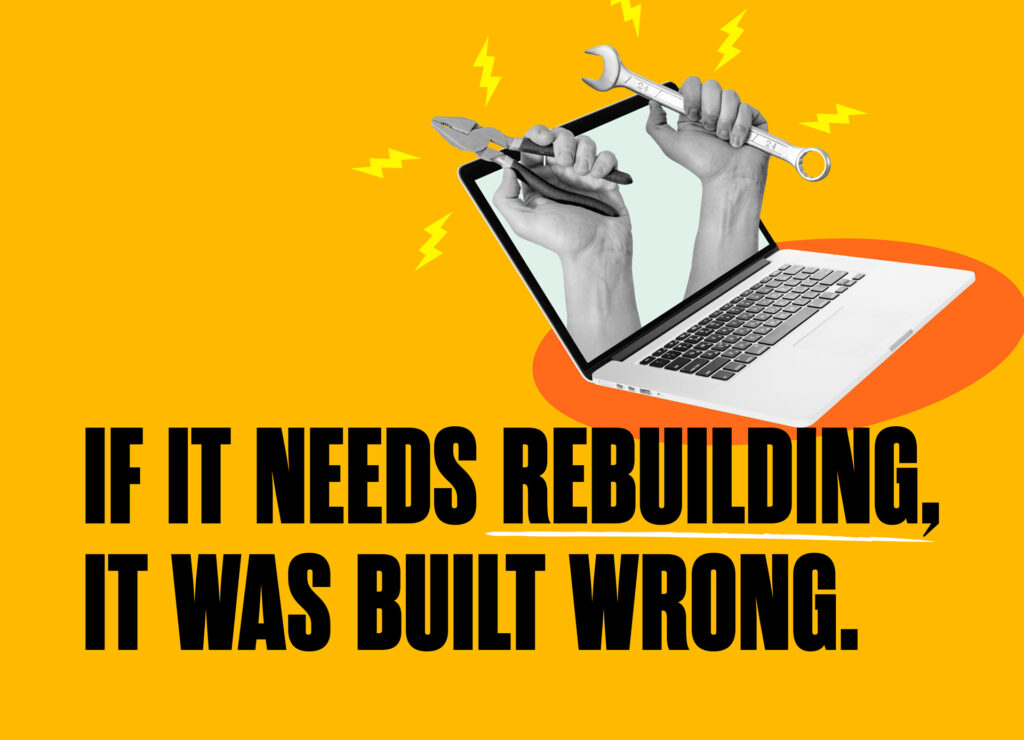
“We need a new website.” This is one of the most common requests we hear from businesses that reach us. Sometimes these come after a few years of use, while at other times they are triggered by a competitor redesign, a brand update, or simply by the feeling that the website looks a bit dated.
On the surface, it sounds reasonable, and trust me, in many cases, it is clearly a necessity. Businesses evolve, and their websites should too. However, it is always worth asking why your website needs to be rebuilt in the first place? If your website needs to be replaced every few years just to keep up, it’s not just a design issue. It is a sign that something deeper isn’t working the way it should.
The pattern
The lifecycle of a website usually follows some familiar patterns.
In some cases, businesses opt for a quick and inexpensive build just to get something live. Those websites tend to hit their limits early and, more often than not, will need to be replaced.
In other cases, businesses spend a decent amount of time and money and a new website is launched. It looks good, reflects the brand, and ticks most of the boxes at the time. There’s momentum, internal buy-in, and a sense that things are finally “in a good place”.
For a while, it works.
Then gradually, things start to shift.
Content becomes outdated. New services or initiatives don’t quite fit into the existing structure. Small changes take longer than they should. Integrations feel limited or disconnected from the rest of the business. Performance may start to slip, or the site simply no longer reflects how the organisation operates today.
And at some point, the conclusion is reached: “We need a new website.”
And the cycle begins again.
What’s going wrong
Generally, it’s easy to assume the core of this issue is the website itself. The design feels dated, the structure no longer fits, or the technology seems limiting. But in most cases, that’s not the real problem. The issue lies in how the website was set up, and more importantly, how it’s been managed since launch.
Built as a project, not a system
Website development projects are usually approached as one-off projects.
There’s a clear start, a defined scope, and a launch date. Once it goes live, the focus shifts elsewhere, often to marketing campaigns, internal priorities, or simply the next item on the list.
But a website doesn’t operate like a finished asset. It sits at the centre of your marketing, sales, and in many cases, operations. Treating it as something that gets “completed” creates a gap between what the business needs over time and what the website is able to support.
No ownership after launch
Once a website is live, responsibility often becomes unclear.
- Who is updating content?
- Who is monitoring performance?
- Who is responsible for improving it?
- Who oversees technical updates?
Without clear ownership, small issues are left unresolved. Updates are delayed. Opportunities are missed. Over time, the website slowly drifts away from the business it’s meant to represent.
Difficult to update or evolve
Even when the intent to improve exists, the structure of the website can get in the way.
Adding new content may require redesigning entire pages. Small updates might depend on a developer. Integrations feel like renovating a house one room at a time without a plan. You end up with doors that lead nowhere and light switches in the wrong place.
Instead of evolving naturally, the website becomes rigid. And once it reaches that point, rebuilding starts to feel like the only option.
No measurement or iteration
Perhaps the most common gap is the absence of meaningful measurement. A lot of businesses that reach us know they have Analytics but have never logged in or even know the credentials to access the account.
Websites are launched without clear success metrics, or with reporting that focuses on surface-level data. While the number of users and time on site are important, it is rare to see businesses that measure conversions, leads, downloads or sales. Without a clear understanding of what is working and what isn’t, there’s no foundation for improvement.
Changes become reactive rather than deliberate. And without iteration, performance doesn’t improve, it stagnates.
The shift: from website to system
While there are many reasons to build a new website, it shouldn’t be something you replace every few years because of the reasons above. In reality, it should be something you run.
The shift from replacing to running may sound subtle, but it changes how decisions are made from the beginning. The focus moves away from launching something that looks good today, towards building something that can adapt, improve and support the business over time.
When a website is treated as a system, it stops from being a standalone asset sitting on the edge of the organisation. It becomes part of how the business operates. It connects and supports your marketing activity, supports your sales process, integrates with your internal tools, and evolves alongside your services, structure and priorities.
The expectation is no longer that it will be “finished”. The expectation is that it will continue to improve.
What this looks like in practice
This doesn’t require constant reinvention. A well-structured website allows for change without disruption.
New pages can be added without redesigning entire sections. Content can be updated regularly without relying on developers for every small adjustment. Integrations are planned from the start, rather than added later as workarounds. Performance is reviewed and improved over time, rather than reset with each rebuild.
Most importantly, decisions are made based on how the website is being used. Where users are leaving the site. What content is performing. Which actions are being taken, and which ones are not.
Instead of guessing what needs to change, there is a clear direction for improvement.
What about design changes?
None of this means design stands still.
In many industries, particularly in fast-paced environments like ecommerce, design needs to evolve regularly. Layouts are refined, user journeys are adjusted, and visual elements are updated based on performance and changing expectations.
But that’s very different from starting again.
When a website is set up properly, design becomes something that can be improved incrementally. Pages can be optimised, components refined, and experiences tested without rebuilding the entire site.
You might update a product page layout, improve navigation, or adjust how content is presented, all without disrupting the underlying structure.
Again, the difference is subtle but important. One approach resets everything. The other builds on what’s already working.
The key to long lasting websites
A rebuild can be necessary in some cases. But it shouldn’t be the plan.
If your website needs to be replaced every few years to keep up, it’s worth stepping back and asking why. Because more often than not, the issue isn’t that the website needs to be rebuilt. It’s that it was never set up, or managed, to run properly in the first place.

