

Globalisation, combined with instant access to real-time information, means we are never truly isolated from world events. The current Middle East tensions and their impact on global fuel supply chains is a clear example. While those within the immediate warzone will inevitably shift their consumption habits, the effects of conflict rarely stay contained. Through rising fuel prices, supply chain disruptions, and broader economic uncertainty, markets far removed from the front line begin to feel the pressure.
Recent reporting already points to declining confidence, heightened fuel anxiety, and early precautionary behaviour, even in regions far from the conflict itself (reuters.com). We’re already seeing this right here in Australia. Households are scaling back to cheaper goods and delaying non-essential spending, while other sectors are maintaining their position or even enjoying unprecedented spending (guardian.com).
It’s easy to default to “keep calm and carry on,” and there’s always a degree of scepticism when agencies advocate for maintaining marketing activity during uncertain times. But this isn’t guesswork. Studies show that brands that stay visible can gain a long-term advantage when conditions recover (digiday.com).
So, in the face of headwinds, many business owners have little control over, it’s important to know how to move forward. Because when buyer behaviour shifts, marketing needs to follow.
Mapping shifts in buyer behaviour through Maslow’s Hierarchy of Needs
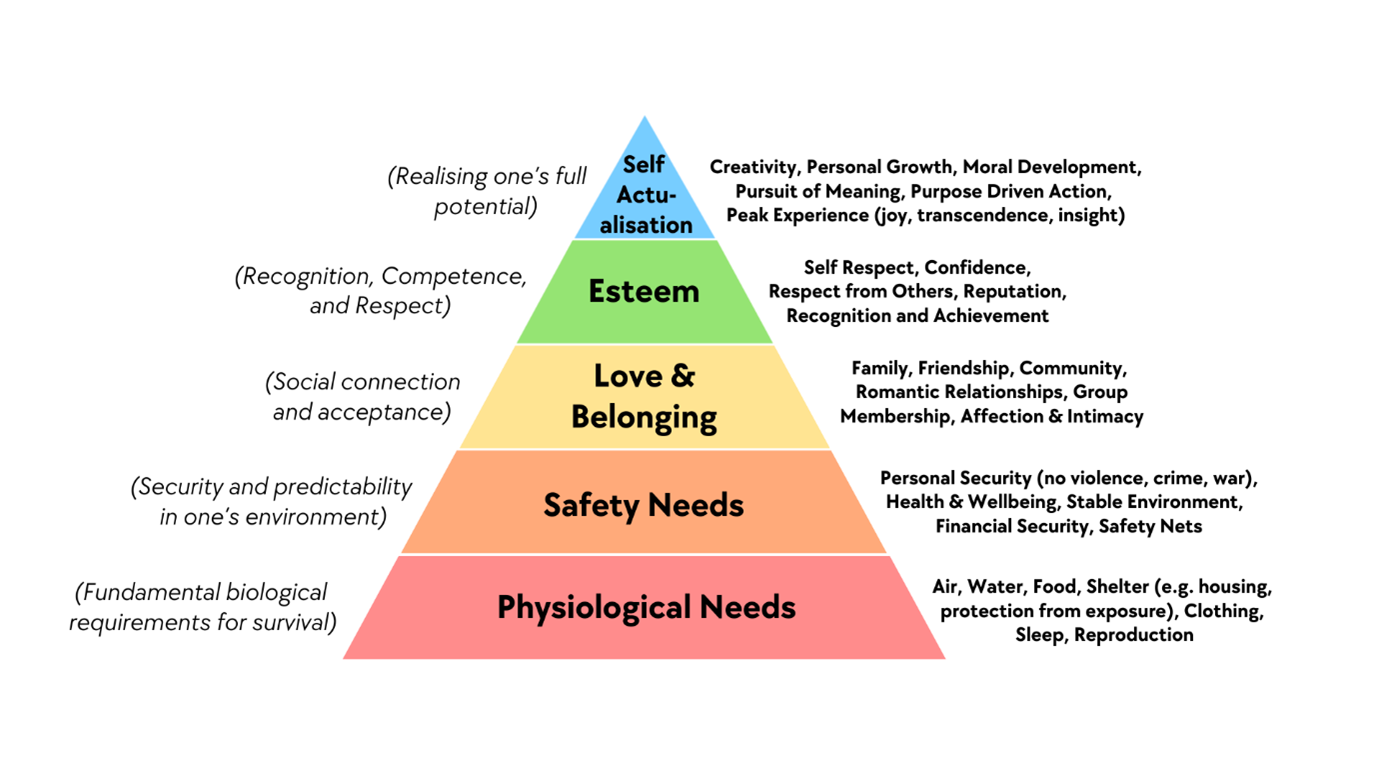
Chances are, if the name doesn’t ring a bell, you have seen this diagram before.
(Image Source: Wikipedia)
Well, this is Maslow’s Hierarchy of Needs, a theory of human motivation presented as a pyramid, with the most basic needs at the bottom, generally taking priority over those further up. To understand how distant conflicts affect buyer behaviour and marketing, this hierarchy helps translate factors like the fuel crisis, war, and economic anxiety into distinct psychological shifts.
In times of uncertainty, behaviour compresses downward through the hierarchy, with lower-level needs taking priority.
Physiological needs
At this most fundamental level of Maslow’s Hierarchy, consumers are concerned about fuel, food and everyday living. Consumers prioritise these essentials over anything else. Where possible, people tend to trade down, substituting pricier alternatives with more economic options. Stockpiling is also a thing… Anyone remember the great toilet paper shortages of 2020?
What brands should do
Fortunately, the world doesn’t stop. And neither should your business. Brands that lean into everyday usefulness outperform those that stick to lifestyle positioning. Remember, consumption doesn’t stop, even for premium products.
Marketing that succeeds is baked in value-led messaging, combined with simplified pricing or offers. It’s important to reduce friction by avoiding complicated messaging or anything that feels like a long-term commitment. Remember, at this stage, consumers are in survival mode.
For premium brands, this is where pressure is felt most. As consumers prioritise essentials, higher-end products must work harder to justify their place in the basket. Messaging that your product is longer-lasting, more efficient, or better value over time will help you connect with people in this state.
Safety and security needs
Consumers are less likely to take risks at this level. Consumer research from VML shows that it reduces consumers’ willingness to commit to large purchases (vml.com).
We’re already seeing some of this play out, with major brands reallocating budgets into flexible performance-led channels. They are still spending, just in a more controllable, risk-averse way (digiday.com) while avoiding long-term commitments. Interestingly, the marketing industry itself is responding in the same way, shifting toward control, flexibility, and risk reduction in line with the same psychological drivers affecting consumers.
What brands should do
At this stage, people are looking for flexibility, reliability and trust. Within your messaging, it is therefore important to build in elements that reduce risk, such as guarantees, return policies or proven outcomes and successful case studies.
By highlighting trust-driven signals, brands can effectively address price sensitivity and risk aversion. Value packs, good-better-best architecture and price transparency are not only tactical details but during uncertainty, they become central brand strategy (sciencedirect.com). For premium brands, establishing certainty and credibility is crucial in convincing consumers to invest in higher-priced products and services.
For categories that live in the luxury space, repositioning your product or service as a ‘need’ rather than a ‘want’ can help. For example, dining out can be seen as a break from pressure or a well-earned treat. Hiring external trades or services will save consumers time and stress. Retailers that focus on everyday value bake reliability into their messaging.
Love and belonging
During the good times and the tough times, human connection plays a large role in our ability to maintain mental health. Previous crises such as COVID-19 demonstrate that social distancing leads to loneliness and anxiety (National Library of Medicine).
One thing we do know is that people still crave connection, normalcy and routine. People don’t stop caring about their friends and family.
What brands should do
Where relevant, brands that lean into facilitating community, human connection and shared experiences should embrace this within their messaging. Even in uncertainty, people don’t stop living; they just become more intentional about it. Restaurants, bars, cafes, and events can be the perfect meeting place, while also feeling “normal”.
During World War II, Procter & Gamble continued to advertise while competitors dropped their spending. Their messaging shifted to embrace family, stability and everyday life, reinforcing normalcy over uncertainty. The outcome was that American consumers perceived buying Procter & Gamble as buying smart, which led to market dominance post-war.
For those premium brands or experiences, build on the chance to meet or escape with friends or family, and consider the human factor in your messaging.
Esteem and self-actualisation
The last two steps of the pyramid are often viewed as ‘growth level’ steps on Maslow’s Hierarchy. But during wars, or cost-of-living pressures, there are still changes in behaviour. Consumers decrease discretionary or luxury spending, or put off large purchases (theguardian.com). However, premium or aspirational brands still succeed, often by leaning into heritage and trust to be perceived as a ‘safe’ asset.
Premium brands that maintain credibility and avoid panic discounting often retain their position, even under pressure. Brands such as Rolex have time and time again proven that they can remain viable in downturns without resorting to discounting.
What brands should do
As we’ve highlighted previously, storytelling or complicated messaging does not hit the mark in uncertain times. And that means brand-building campaigns or long-term plays become less effective if not adapted to the environment. Grunert et al, (2023) found that the dominant response to the Ukraine war price shock across 10 European countries was greater price sensitivity, suggesting marketing must solve affordability before it can sell aspiration.
For brands positioning themselves in ‘wants’, aspiration, and luxury, focus your messaging on longevity, trust, and practical benefits. At this point in time consumers are less concerned about aspiration than they are with necessity, so the need to justify the purchase is higher.
That being said, at the luxury end of the scale, there will be a group of consumers that simply are not impacted at all by any of the turbulence caused by a war or cost of living crises. For them, it’s business-as-usual. However, for 99% of the population, it is anything but that.
Spotting the patterns in your industry
Each industry and consumer group will move at their own pace, but across academic research and current industry reporting, the same pattern emerges. Crisis shifts consumers down Maslow’s Hierarchy of Needs.
Consumer or buyer behaviour becomes more risk-averse, more value-driven and control-oriented. But people continue to spend and from a marketing perspective, it is imperative you shift to meet these consumers at their level. This is generally achieved by enabling consumers to justify their purchase, demonstrating trust and heritage, and providing reassurance or flexibility through your brand offers.
And while there is a temptation to bunker down and sit it out, history has shown that maintaining a presence will lead to a faster return or a larger market share when things stabilise again.

